



What can Shakespeare’s Coat of Arms teach us about Theatre History?
 Callan Davies
Lecturer in Seventeenth-Century Literature and Culture
I research and teach Shakespeare and early modern theatre history.
Curtain Playhouse
Playhouse and Biography
callan.davies@englsoton.work
In 1599, the playwright Ben Jonson made a thinly veiled joke about Shakespeare. A character in his play Every Man Out of his Humour muses on his social status, happy that he “can write myself gentleman now.” “Here’s my patent,” he boasts, “it cost my thirty pound, by this breath.” Gentility was up for sale in late Elizabethan England, or so this city comedy was at pains to suggest. In the play, the new gentleman’s friends lean over to scrutinise the coat of arms that came with the title, a Boar without a head, rampant (in a standing position): an upright headless pig. It’s a funny fictional emblem in itself, which isn’t lost on those in the play. Among some forensic detail about the commissioning of the design, one person quips that the best motto for this butchered coat of arms would be “Non Sanz Mustard” (not without mustard).
A few years earlier, Shakespeare had secured for his father a coat of arms, which included the suggested motto Non sanz droict (Not without right). Jonson’s jibe isn’t subtle. The Shakespeares had updated it just months before the comedy, in a bid to merge in the Arden coat of arms, and he would well have understood his fellow playwright’s jesting and the potential silliness around contemporary heraldry.

A year earlier, the Merry Wives of Windsor opened at the Curtain with an extended discussion of one character’s arms, made up of 12 white fish. The characters imagine dividing it up, like fishmongers, as a consequence of marriage.
The joke on Shakespeare and the joke by Shakespeare are essentially the same: coats of arms, in this day and age, are little more than market commodities, and noisome ones to boot.
The perceived inventiveness involved in this form of social mobility was clearly not lost on Shakespeare, even as he planned his own family’s ancestral claims. His father John had petitioned for a coat of arms as early as the 1570s, in the wake of his service as bailiff (essentially “mayor”) of Stratford. But it wasn’t until his son assisted in the 1590s that the heralds’ formally recognised family’s gentlemanly status.
A coat of arms served as a sign that one’s family was of noble or gentle stock, and it occasioned, at times, some creative genealogy. In what remained a relatively hierarchical society (even as those hierarchies were shifting), the prospect of being styled a “gentleman” with a coat of arms appealed to those whose families had no current evidence for their nobility, even if some protested it was increasingly often too easy and too spurious. Think: some wishful thinking and a few hyperlinked connections in an Ancestry.com family tree, and suddenly you’re the Earl of Somewhere’s great, great, great, great grandchild…
One figure directly links the world of playing with this increasingly in-demand world of heraldry. The Cheshireman William Smith wore many coats, as it were: haberdasher, antiquarian scholar, map maker, and herald.
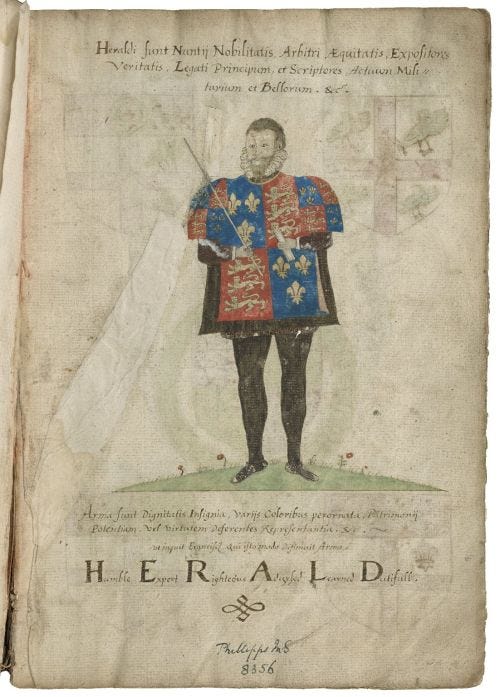
Smith apprenticed and then worked as a haberdasher and merchant before pursuing an interest in travel and topography. He wrote several manuscripts and published works exploring local history, including accounts of London’s past and the history of his home county of Cheshire. He drew fascinating sketches of various towns and cities of late Elizabethan London and recorded the distances and routes required to move between them (a subject for a future post). In 1597, Smith was appointed “Rouge Dragon pursuivant”: an officer post in the College of Arms.
In his role, Smith assessed claims for coats of arms and drew up designs. Heraldry was closely related to antiquarianism; both, after all, involve genealogy and diligent research on historical precedent. His fastidious interest in the past made him sceptical of some recent claims, and he excoriated his colleagues in the field, and in particular painters who worked on commission, for their ignorance and their over-indulgence of prospective claimants.
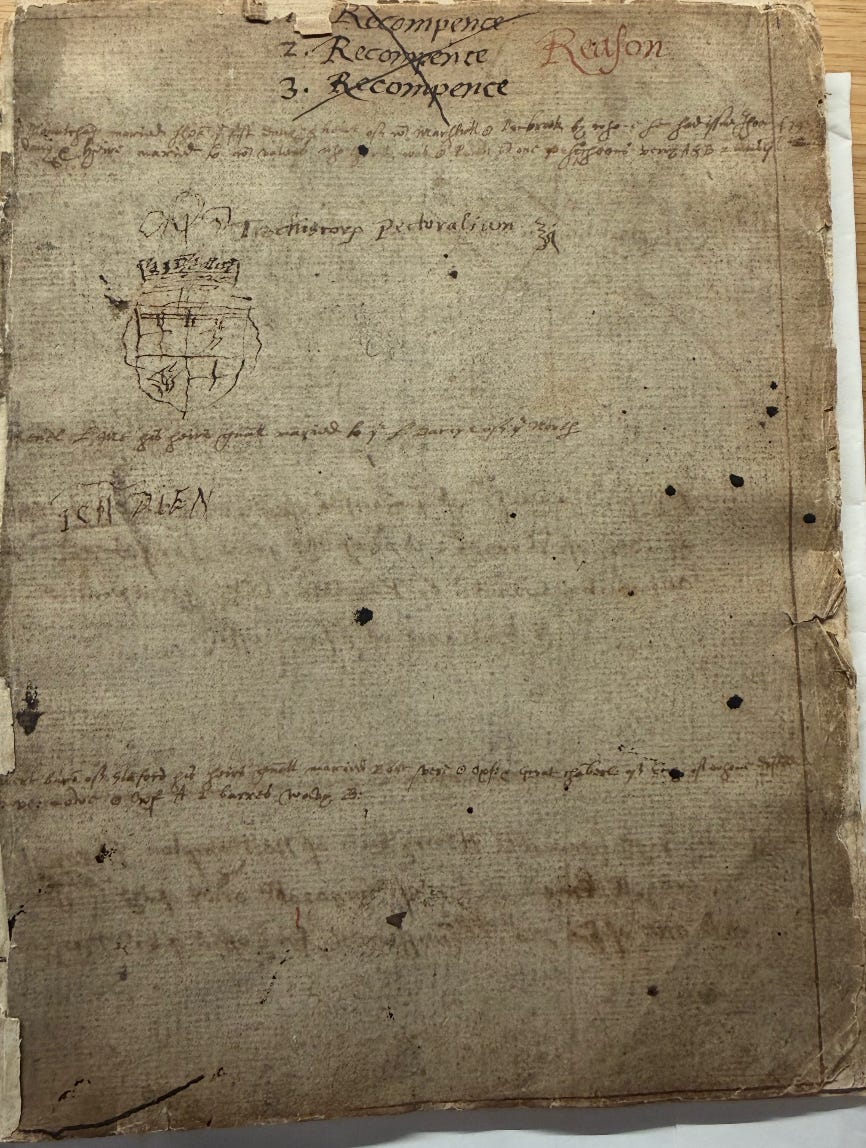
In 1605, Smith drew up a manuscript bemoaning in particular the past 9 years of errors and excesses—coincidentally the exact date the Shakespeares gained their arms. He pointed out that novices and contractors gained preferment in commissions over proper and established officers. Notably, he also criticised the poor handiwork or design of those involved. Not quite Jonson’s headless pigs galore, exactly, but plenty to complain about. “The faults” of seal-makers (for stamping wax in letters and documents) and painters “are Innumerable,” he observes.
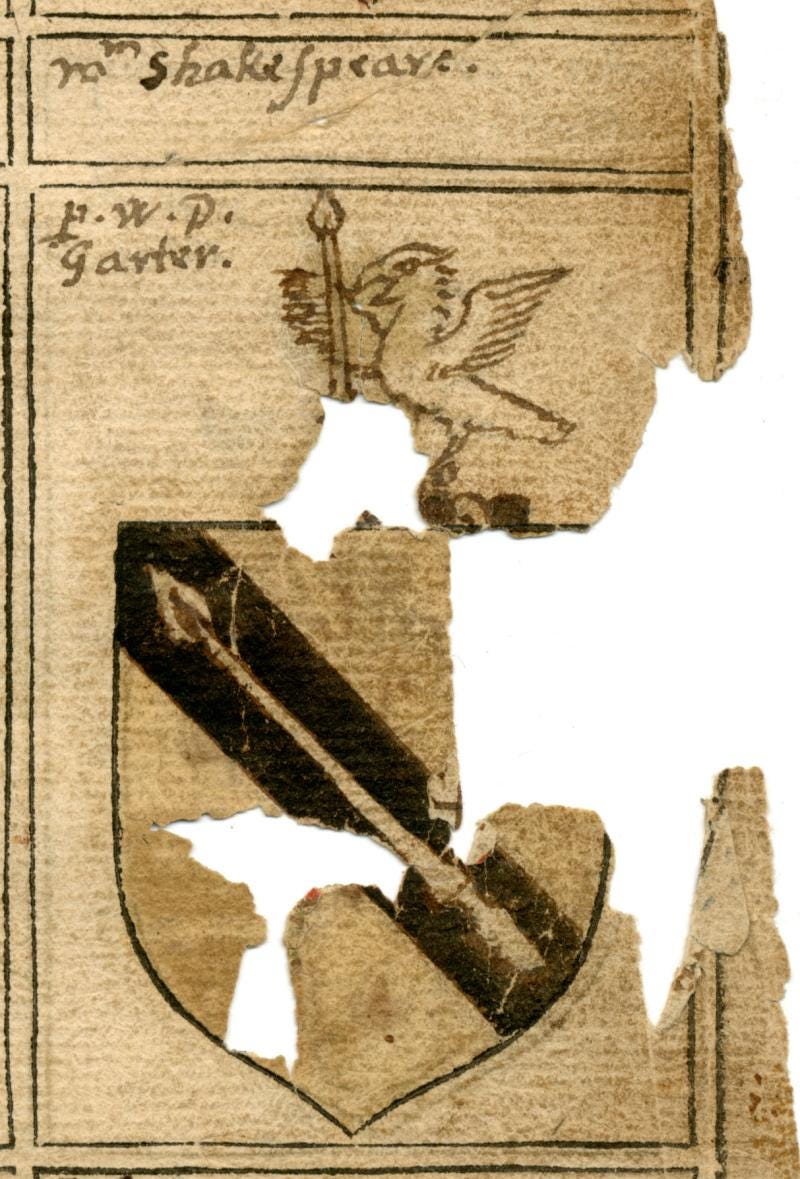
Two of his prime examples were Shakespeare’s close colleagues in the Chamberlain’s and then King’s Men, Augustine Phillips “the player” and Thomas Pope “the player.” The latter (who passed away in 1603) had been a shareholder in the Curtain. Smith suggests both had questionable coats of arms, as a result of painter-graver excesses. Just as with Shakespeare, players were increasingly looking to shore up their new-found wealth and reputations, even through less reliable means. Smith knew the company well and had even drawn Shakespeare’s own crest in 1602:
For all his quibbles with certain actorly entitlement, Smith was perfectly at home in the playhouse. Along with his other talents, he was a playwright. He’d even written a drama possibly performed by Shakespeare’s company called The Freeman’s Honour (its subject seemingly cleaving close to his interest in citizenship, pride, and identity). And he went on to write the only play that advertises the Curtain playhouse on its title page—The Hector of Germany (1613). The drama was itself heraldry. It celebrated the marriage of Princess Elizabeth by way of the dynastic conflicts of medieval Europe, by way of shipwrecks and jousting tournaments and including asides like an induction into the order of the garter. Notably, it wasn’t professional players who staged it but city workers. Smith had found a way to unite his various passions: heraldry, antiquarian research, citizenship and occupational identity, and display.
The Curtain therefore had an unlikely side hustle, in the midst of its life, as a theatrical College of Arms. Jonson and Shakespeare conducted lengthy and occasionally abstruse analysis of fictionalised coats of arms before assembled crowds, and a decade and a half later the Rouge Dragon pursuivant himself transformed the stage into a living, breathing coat of arms with battles, colourful ensigns and escutcheons, and a ranging storyline. Smith believed deeply that such matters ought, at least, to be “not without right” (as the Shakespeares styled their motto). Plenty in the crowd, though, would sense the mustard in there too.
This post first appeared on Callan’s substack The Shakespeare Stage.